


Cloud computing has revolutionized how businesses operate in 2025. With global spending reaching $723.4 billion this year alone, organizations worldwide are embracing this technology for its flexibility and efficiency.
But what is cloud computing exactly?
It’s the delivery of computing services including servers, storage, databases, and software over the internet. Instead of owning physical hardware, businesses rent these resources on-demand. End-user spending on public cloud services worldwide is forecasted to total $723.4 billion in 2025, up from $595.7 billion in 2024. This 21.5% increase reflects the growing adoption of AI and hybrid cloud strategies across industries. Understanding the pros and cons of cloud computing helps businesses make informed decisions.
This comprehensive guide explores both advantages and disadvantages to help you weigh the pros and cons effectively.
Essential Cloud Computing Facts for 2025
| Metric | 2025 Statistics | Business Impact |
| Global Market Value | $912.77 billion | 21.2% CAGR growth to 2034 |
| Enterprise Adoption | 96% using public cloud | Nearly universal adoption |
| Security Improvements | 94% report better security | Enhanced protection post-migration |
| Cost Optimization Challenge | 82% struggle with spend management | Top concern for decision-makers |
| Multi-cloud Strategy | 92% adopt multi-cloud | Risk mitigation and flexibility |
| AI Integration | 79% using AI/ML services | Driving innovation and efficiency |
What is Cloud Computing?
Cloud computing is the on-demand delivery of IT resources over the internet with pay-as-you-go pricing.
The characteristics of cloud computing include on-demand self-service, broad network access, resource pooling, rapid elasticity, and measured service. These features make cloud technology attractive to businesses of all sizes. Cloud service models include Software as a Service (SaaS), Platform as a Service (PaaS), and Infrastructure as a Service (IaaS). Each model offers different levels of control and management responsibility. 75% of enterprises are focusing on developing cloud-native applications. This shift demonstrates how cloud computing has become central to modern business strategy.

What Are the Top 10 Advantages of Cloud Computing?
Cloud computing offers significant benefits including cost savings, scalability, accessibility, automatic updates, collaboration, disaster recovery, sustainability, global reach, security, and faster deployment.
1. Cost Savings Through Reduced Hardware Investments
Cloud computing eliminates expensive upfront hardware purchases. Instead of buying servers costing $10,000-$50,000 each, businesses pay monthly fees starting around $100-$500.
Traditional data centers require cooling systems, backup power, and physical security. No large upfront capital costs because a company moving to the cloud doesn’t have to purchase physical servers, network storage, cooling systems and disaster recovery systems.
Cloud providers handle maintenance, reducing IT staff costs by 30-50%. Small businesses save an average of $15,000-$30,000 annually on IT infrastructure.
2. Scalability and Flexibility for Growing Businesses
Public cloud resources scale instantly during peak demand. E-commerce sites can handle Black Friday traffic spikes without crashing. Cloud infrastructure adjusts automatically to business needs. A startup can begin with minimal resources and expand globally without rebuilding systems.
96% of companies are expected to use public cloud services in 2025. This widespread adoption reflects the scalability advantages cloud solutions provide.
3. Improved Accessibility and Remote Work Capabilities
Employees access data in the cloud from anywhere with internet connection. This flexibility enabled 40% productivity increases during remote work transitions.
Cloud storage services synchronize files across devices automatically. Teams collaborate in real-time using shared documents and applications. Mobile workforce productivity improves by 25-35% with cloud computing services. Geographic barriers disappear when data lives in the cloud.
4. Automatic Software Updates and Maintenance
Cloud service providers manage all system updates automatically. Security patches deploy instantly without business disruption.
Traditional software requires manual updates costing $5,000-$15,000 annually per application. Cloud computing includes these updates in monthly fees. IT teams focus on strategic projects instead of routine maintenance. This shift increases innovation capacity by 40-60%.
5. Enhanced Collaboration Tools
Cloud platforms enable real-time document editing and sharing. Teams complete projects 25% faster using integrated collaboration features. Video conferencing, file sharing, and project management integrate seamlessly. Google Cloud, Microsoft 365, and similar platforms streamline teamwork. Remote teams maintain productivity levels matching in-office performance. Cloud computing facilitates collaboration across time zones and continents.
6. Disaster Recovery Benefits
Cloud storage provides automatic backup and recovery capabilities. Data replicates across multiple geographic locations for redundancy.
Traditional disaster recovery costs $50,000-$200,000 to implement. Cloud-based solutions start at $500-$2,000 monthly with superior protection. Recovery times decrease from days to hours. 94% of businesses noted improvements in their security after moving to the cloud.
7. Environmental Sustainability
Cloud data centers achieve 80% better energy efficiency than traditional setups. Shared resources reduce overall carbon footprint.
Global energy consumption by cloud data centers represents 1% of the world’s energy consumption. This efficiency improves as providers invest in renewable energy. Businesses reduce their environmental impact by 65% when migrating to cloud. Green computing becomes achievable for organizations of all sizes.
8. Global Reach and Availability
Cloud providers operate data centers worldwide. Applications load quickly regardless of user location.
Content delivery networks reduce latency by 60-80%. Global businesses serve customers efficiently without building local infrastructure. 99.9% uptime guarantees ensure constant availability. Cloud computing eliminates geographic limitations for business expansion.
9. Improved Security Features
Cloud providers offer advanced security measures exceeding most internal capabilities. Enterprise-grade encryption protects data in transit and at rest.
Security teams monitor threats 24/7 using AI-powered detection systems. Compliance certifications include HIPAA, SOC 2, and GDPR. Cloud security budgets reach $50 billion annually. Individual businesses access this protection for fraction of the cost.
10. Faster Time-to-Market for Applications
Development teams deploy applications in minutes instead of weeks. Cloud platforms provide pre-configured environments and development tools.
Time-to-market reduces by 40-60% using cloud computing. Startups compete with established companies through rapid deployment capabilities. Continuous integration and deployment streamline software releases. Cloud technology accelerates innovation cycles across industries.
What Are the 10 Major Disadvantages of Cloud Computing?
Cloud computing disadvantages include security concerns, internet dependency, vendor lock-in, ongoing costs, compliance challenges, potential downtime, speed limitations, customization restrictions, hidden fees, and loss of physical control.
1. Security and Privacy Concerns with Data Breaches
About 45% of security incidents are reported to have originated from cloud environments. Data breaches can expose sensitive customer information and intellectual property. Cloud security requires shared responsibility between providers and customers. Misconfigurations cause 23% of security incidents according to recent studies.
Third-party access raises privacy concerns. According to Gartner, through 2025, 99% of all cloud security failures will be due to some level of human error.
2. Internet Dependency and Connectivity Issues
Cloud services become inaccessible during internet outages. Businesses lose productivity when connectivity fails.
Slow internet speeds affect performance. Rural areas with poor connectivity struggle with cloud computing adoption. Bandwidth costs increase with heavy usage. Data transfer fees can surprise businesses with large file requirements.
3. Vendor Lock-in and Limited Control
Cloud service provider platforms use proprietary formats and APIs. Switching to cloud alternatives becomes expensive and complex.
Migration between providers costs $50,000-$500,000 for enterprise applications. Vendor dependency limits negotiating power. Platform changes affect business operations. Cloud suppliers control infrastructure decisions impacting your systems.
4. Ongoing Subscription Costs That Can Accumulate
Monthly fees continue indefinitely unlike one-time software purchases. Managing cloud spend is reported as the main challenge facing cloud decision-makers, cited as their top concern by 82% of respondents.
Cloud computing costs can exceed traditional infrastructure over 5-7 years. Poor optimization leads to resource waste and overspending. Usage spikes cause unexpected bills. Auto-scaling features can generate massive costs without proper controls.
5. Compliance Challenges for Regulated Industries
Healthcare and finance face strict regulatory requirements. Data stored in the cloud must meet HIPAA, PCI-DSS, and other standards.
International data sovereignty laws complicate public cloud adoption. Some regulations require data to remain within specific geographic boundaries.
Audit complexity increases with cloud providers. Compliance responsibility remains with the business despite outsourced infrastructure.
6. Potential Downtime from Provider Outages
Cloud provider outages affect multiple customers simultaneously. Major incidents can last several hours impacting business operations. Servers are the targets of 90% of security breaches. Single points of failure can cascade across cloud infrastructure. Service level agreements provide credits but don’t compensate for lost revenue. Critical systems require backup plans during outages.
7. Data Transfer Speed Limitations
Large file uploads and downloads take significant time. Video production and engineering firms struggle with bandwidth limitations. Latency affects real-time applications. Gaming and trading platforms require low-latency connections for optimal performance. Peak usage periods slow network performance. Shared infrastructure creates bottlenecks during high-demand periods.
8. Limited Customization Options
Cloud platforms offer standardized environments with limited flexibility. Custom configurations may not be available or cost extra.
Legacy applications might not work properly in cloud computing environments. Integration challenges arise with specialized systems. Cloud service features depend on provider offerings. Unique business requirements might not align with available options.
9. Hidden Costs and Unexpected Charges
Data transfer fees, API calls, and premium support generate additional charges. Egress fees for moving data out can reach thousands monthly. Storage costs compound over time. Old data and snapshots accumulate charges without proper lifecycle management. Support tiers require additional payments. Enterprise-level assistance costs extra beyond basic cloud service packages.
10. Loss of Physical Control Over Data
Data in the cloud resides on servers you don’t control. Physical security depends entirely on cloud provider measures. Government access requests can expose data without your knowledge. International jurisdiction issues complicate data protection. Disaster recovery depends on provider capabilities. Business continuity relies on external infrastructure and processes.

What Are the Advantages and Disadvantages of Cloud Computing for Small Businesses?
Here are the advantages and disadvantages of cloud computing for small businesses:
Pros: Access to Enterprise-Level Technology
Small businesses gain access to sophisticated tools previously only available to large corporations. Enterprise-grade security, analytics, and AI services become affordable through cloud computing.
Professional IT support is included in cloud service packages. Small teams access 24/7 technical assistance without hiring specialized staff. Competitive advantage emerges through advanced capabilities. Cloud technology levels the playing field against larger competitors.
Cons: Ongoing Subscription Costs
Monthly fees strain tight budgets compared to one-time purchases. About 44% of traditional small businesses use cloud infrastructure or hosting services.
Internet dependency creates vulnerability for businesses with poor connectivity. Rural locations struggle with reliable cloud computing access. Learning curves require staff training time and resources. New cloud platforms demand skill development investments.
What Are the Advantages and Disadvantages of Cloud Computing for Large Enterprises?
Below are the advantages and disadvantages of cloud computing for a large enterprise:
Benefits: Massive Scalability
Enterprise cloud computing supports millions of users and transactions. Global deployment becomes possible without building data centers worldwide.
Reduced data center costs save millions annually. Legacy infrastructure replacement accelerates through cloud migration. Enhanced collaboration connects distributed teams across continents. Hybrid cloud strategies optimize performance and costs.
Drawbacks: Complex Vendor Negotiations
Enterprise contracts involve millions of dollars and complex terms. Vendor negotiation processes can take 6-12 months to complete.
Integration challenges with legacy systems require extensive planning. Data migration projects cost $500,000-$5 million for large organizations. Compliance complexities multiply across multiple jurisdictions and regulations. Enterprise cloud security requirements demand specialized expertise.
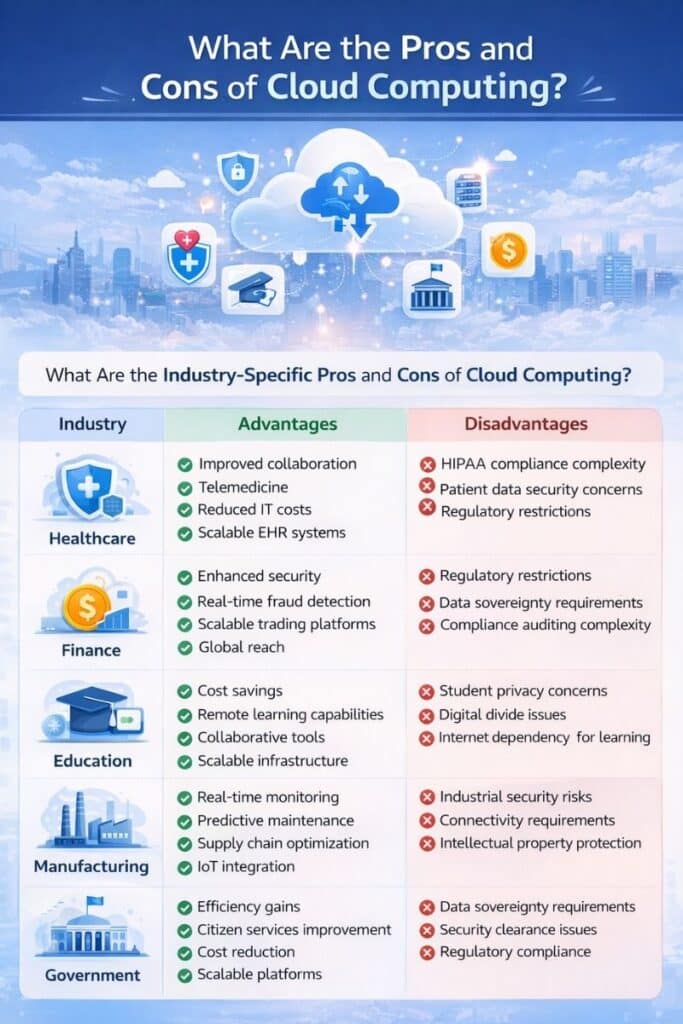
What Are the Industry-Specific Pros and Cons of Cloud Computing?
| Industry | Advantages | Disadvantages |
| Healthcare | Improved collaboration, telemedicine, reduced IT costs, scalable EHR systems | HIPAA compliance complexity, patient data security concerns, regulatory restrictions |
| Finance | Enhanced security, real-time fraud detection, scalable trading platforms, global reach | Regulatory restrictions, data sovereignty requirements, compliance auditing complexity |
| Education | Cost savings, remote learning capabilities, collaborative tools, scalable infrastructure | Student privacy concerns, digital divide issues, internet dependency for learning |
| Manufacturing | Real-time monitoring, predictive maintenance, supply chain optimization, IoT integration | Industrial security risks, connectivity requirements, intellectual property protection |
| Government | Efficiency gains, citizen services improvement, cost reduction, scalable platforms | Data sovereignty requirements, security clearance issues, regulatory compliance |
Markets and Markets has estimated global healthcare to be $53.8 billion in 2024. Healthcare leads cloud computing adoption despite regulatory challenges.
Financial services achieve 75% cloud adoption rates. Enhanced security and scalability outweigh regulatory concerns for most institutions. Education sector realizes 40% cost savings through cloud solutions. Remote learning capabilities became critical during global disruptions.
Frequently Asked Questions
What are the 5 main advantages of cloud computing?
The 5 advantages of cloud computing include cost savings, scalability, accessibility, automatic updates, and enhanced collaboration. These benefits of cloud computing drive widespread adoption across industries.
What are the 5 main disadvantages of cloud computing?
The five disadvantages of cloud computing are security concerns, internet dependency, vendor lock-in, ongoing costs, and compliance challenges. Understanding these helps businesses weigh the pros and cons.
What are the biggest risks of using cloud computing?
The risks with cloud computing include data breaches, service outages, vendor lock-in, compliance violations, and loss of control. 27% of businesses have encountered security breaches in their public cloud infrastructure.
Is cloud computing more cost-effective than traditional IT?
Cloud computing typically offers better cost-effectiveness through reduced upfront investments and operational expenses. However, long-term costs can exceed traditional infrastructure without proper optimization.
What are the security pros and cons of cloud storage?
Cloud storage provides enterprise-grade security and automatic backups. However, shared infrastructure and third-party access create potential vulnerabilities requiring careful management.
What are the pros and cons of cloud computing for students?
Advantages and disadvantages of cloud computing for students include anywhere access to learning materials versus internet dependency and potential privacy concerns with educational data.
What industries benefit most from cloud computing advantages?
Technology, healthcare, finance, and education industries benefit most from cloud computing advantages. These sectors leverage scalability, collaboration, and advanced analytics capabilities effectively.
What are the hidden disadvantages of cloud computing?
Hidden cons of cloud computing include unexpected costs, limited customization, vendor dependency, and reduced control over infrastructure. Data transfer fees and compliance complexity add unforeseen challenges.
Wrapping Up
Cloud computing offers transformative benefits including cost savings, scalability, and enhanced collaboration. However, businesses must carefully consider security concerns, vendor dependency, and ongoing costs. The pros of cloud computing generally outweigh the disadvantages for most organizations. 51% of IT spending will shift from traditional tools to cloud solutions by 2025.
Successful cloud adoption requires thorough planning, proper security implementation, and ongoing cost optimization. Understanding the pros and cons enables informed decision-making for your specific business needs.
Whether you move to the cloud depends on your industry, size, and requirements. Hybrid cloud solutions often provide the best balance of benefits while addressing specific concerns. The future clearly favors cloud technology. Organizations that embrace this transformation thoughtfully will gain competitive advantages in an increasingly digital world.


