


As a Los Angeles business owner, you’ve likely reached that critical decision point: your company is growing, technology demands are increasing, and your break-fix IT approach isn’t cutting it anymore.
But what’s next?
Should you hire dedicated IT staff, contract for managed capacity, or partner with a managed services provider?
And honestly, it can be pretty confusing if you’re not deep in the IT world every day.
What Is Managed Capacity in IT Services?
Managed capacity is like having part-time IT employees without the hiring headaches. Your provider assigns specific technicians to work exclusively for your business for a set number of hours each week or month.
Think of it as renting dedicated IT staff. For example, a 25-person accounting firm in Santa Monica might contract for 20 hours of IT support weekly, with the same network administrator showing up every Tuesday and Thursday.
You pay for a certain capacity whether that’s measured as hours per week or percentage of a full-time equivalent (FTE). The technicians become familiar with your environment but are employed by the service provider, saving you the overhead of full-time hiring, benefits, and training.
It’s pretty straightforward, really.
What Are Managed IT Services?
Managed services flips the model by focusing on outcomes rather than dedicated time. Instead of paying for hours, you pay for results like “fully managed and secured IT infrastructure” or “99.9% network uptime.”
A managed service provider (MSP) like ClearFuze delivers comprehensive technology solutions through a team-based approach using shared resources deployed flexibly based on your needs.
Rather than getting one person for set hours, you get access to an entire team of specialists with diverse expertise.
Overview of Managed Capacity Model
In practice, managed capacity works well for businesses with moderate, predictable IT needs.
A 15-person manufacturing company in Torrance might contract for a dedicated IT technician every Monday and Wednesday, knowing exactly who will show up and what they’ll focus on. The benefits include consistency in personnel and predictable availability. Your dedicated technician learns your environment deeply and builds relationships with your team. It’s nice having the same face show up consistently.
However, limitations become apparent as businesses grow.
- What happens when your dedicated resource calls in sick or takes vacation?
- What if a critical server crashes on a Friday when your IT capacity is scheduled for Mondays and Wednesdays?
And what about specialized needs like cybersecurity compliance or cloud migrations that your general IT technician may not specialize in?
According to a 2023 CompTIA study, 46% of businesses that switched from managed capacity to managed services cited coverage limitations as their primary reason for change, with after-hours support being the most significant gap.
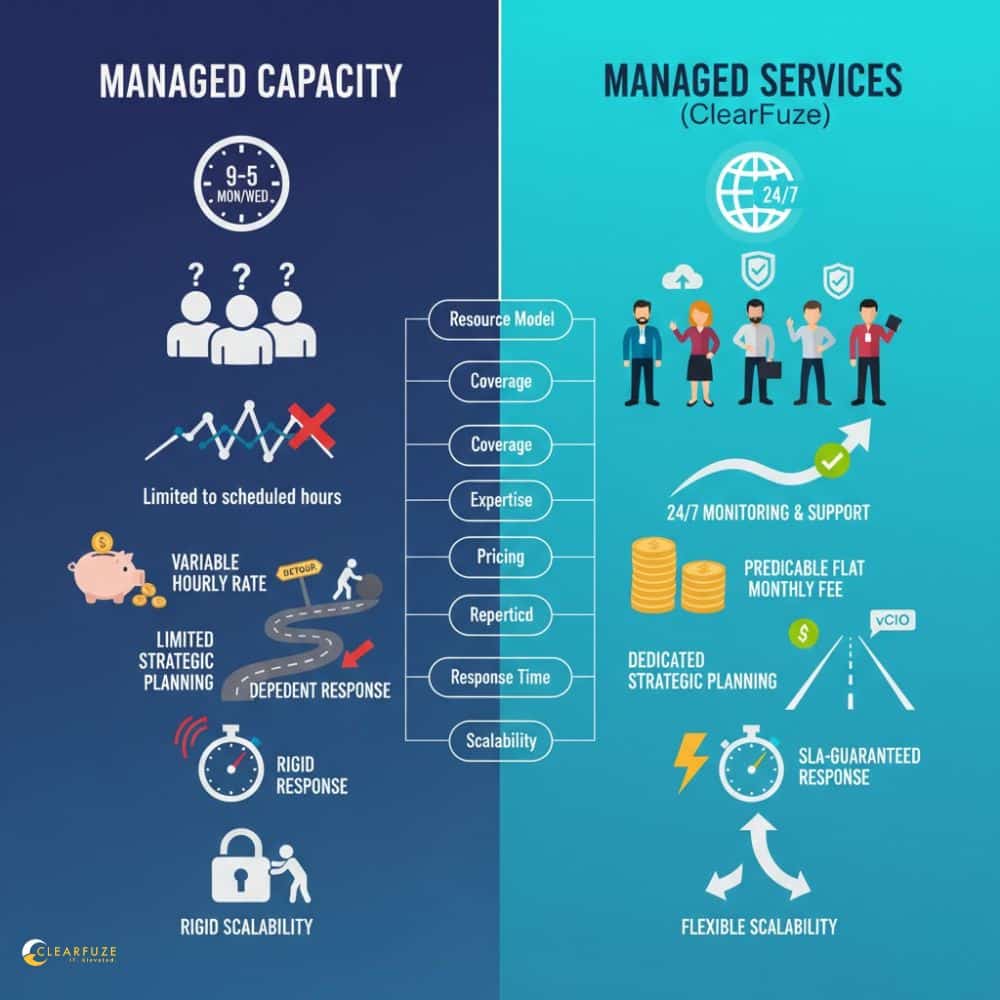
Managed Capacity vs Managed Services: Key Differences
| Feature | Managed Capacity | Managed Services (ClearFuze) |
| Resource Model | Dedicated individuals for set hours | Team of specialists available as needed |
| Coverage | Limited to scheduled hours (e.g., 9-5 Monday/Wednesday) | 24/7 monitoring and support |
| Expertise | Generalist knowledge from few individuals | Specialized team with diverse certifications |
| Pricing | Hourly or FTE-based (variable with overages) | Flat-rate monthly fee (predictable) |
| Strategic Planning | Limited by technician’s experience | Dedicated vCIO and strategic roadmapping |
| Response Time | Depends on contracted hours and availability | SLA-guaranteed response times |
| Scalability | Requires contract renegotiation to add hours | Flexes with business needs automatically |
Consider how these differences played out for a 30-person healthcare practice in Glendale.
With their previous managed capacity provider, they experienced an 8-hour outage when ransomware hit their systems on a weekend.
After switching to ClearFuze‘s comprehensive cybersecurity services , similar attempts were detected and blocked immediately by 24/7 security monitoring, preventing any downtime.
When Should You Choose Managed Services?
Managed services typically provides better value when:
- You need comprehensive coverage across multiple technology domains (network, security, cloud, end-user support)
- Your business requires 24/7 monitoring and rapid incident response
- You want predictable, flat-rate IT costs without surprise bills
- Compliance requirements (HIPAA, FINRA, etc.) demand specialized expertise
- Your business is growing and needs scalable IT support
- Strategic technology planning is critical to your competitive advantage
At ClearFuze, we’ve seen this firsthand with clients like a 45-person law firm in Downtown LA. They previously used a managed capacity model with 30 hours of support per week from a dedicated technician. While their day-to-day needs were met, they struggled with strategic planning and specialized projects.
After switching to our virtual CIO services , they gained access to our CISSP-certified security professionals for their compliance needs, cloud specialists for their Office 365 migration, and strategic guidance that helped them implement a document management system that reduced case processing time by 35%. That’s real business impact, not just IT support.
How to Choose the Right IT Service Model for Your Business
To determine which model fits your organization, assess:
- Technology Complexity: Simple environments with few applications may work with managed capacity. Complex multi-vendor environments with cloud integrations benefit from managed services.
- Growth Trajectory: Fast-growing companies need the scalability of managed services. Stable businesses might be fine with fixed capacity.
- Risk Tolerance: Organizations handling sensitive data (financial firms, healthcare providers) typically need the comprehensive security approach of managed services.
- Budget Structure: Do you prefer variable IT costs (managed capacity) or predictable monthly expenses (managed services)?
- Strategic Importance of IT: Is technology merely a utility or a strategic differentiator for your business?
Ask yourself: What happens if your server crashes at 2 AM? What if your dedicated IT person quits? How quickly can you scale up support during growth phases or special projects?
A 20-person manufacturing firm in Long Beach faced this decision last year. Their operations ran on specialized ERP software critical to production, but they had limited in-house IT expertise. While managed capacity seemed cheaper initially, they realized a single IT generalist couldn’t provide the specialized knowledge needed for their ERP system, cloud security, and strategic planning.
After consulting with ClearFuze, they chose our managed services model and gained access to our entire team of specialists for less than the cost of hiring one mid-level IT employee. Their production downtime decreased by 73% in the first year. Pretty impressive, right?
A 2024 Deloitte Tech Trends report found that businesses using managed services models reported 43% faster resolution times for IT incidents and 37% lower total cost of ownership compared to traditional staffing models.

Choosing Between IT Models
- Choose Managed Capacity if: Your IT needs are basic, predictable, and limited to business hours; you have minimal compliance requirements; and you value having the same individual consistently.
- Choose Managed Services if: You need comprehensive coverage, 24/7 protection, access to specialists, strategic guidance, and predictable IT costs that scale with your business.
Frequently Asked Questions
Is managed capacity cheaper than managed services?
Initially, managed capacity may appear less expensive with its hourly rate structure. However, when accounting for coverage gaps, emergency response costs, and specialized expertise needs, managed services often provide better total value through predictable pricing and comprehensive coverage.
What is included in managed IT services?
ClearFuze‘s managed IT services include 24/7 monitoring, help desk support, cybersecurity protection, backup management, cloud services, strategic planning, vendor management, and proactive maintenance, all bundled into a predictable monthly fee structure.
Can managed services scale with business growth?
Absolutely. Unlike managed capacity that requires contract adjustments, managed services naturally scale with your business. As you add users, locations, or technology, your MSP adjusts resources accordingly without renegotiating terms or experiencing support gaps.
What are the risks of managed capacity models?
The primary risks include coverage gaps during off-hours or absences, knowledge concentration in few individuals, limited specialized expertise, difficulty scaling during growth or projects, and potential for unexpected overage costs when issues exceed contracted hours.
Next Steps: Find Your Ideal IT Support Model
- Audit your current IT pain points and create a list of must-have support requirements
- Evaluate your growth plans for the next 24 months and how IT needs might change
- Calculate the true cost of IT downtime for your specific business
- Consider compliance requirements in your industry
- Schedule a consultation with ClearFuze to assess which model aligns with your business goals
Ready to determine whether managed capacity or managed services is right for your business? ClearFuze offers free IT assessments for qualified Los Angeles businesses. Contact our team today at ClearFuze to discover how our team of experts can transform your technology from a cost center to a competitive advantage.


